
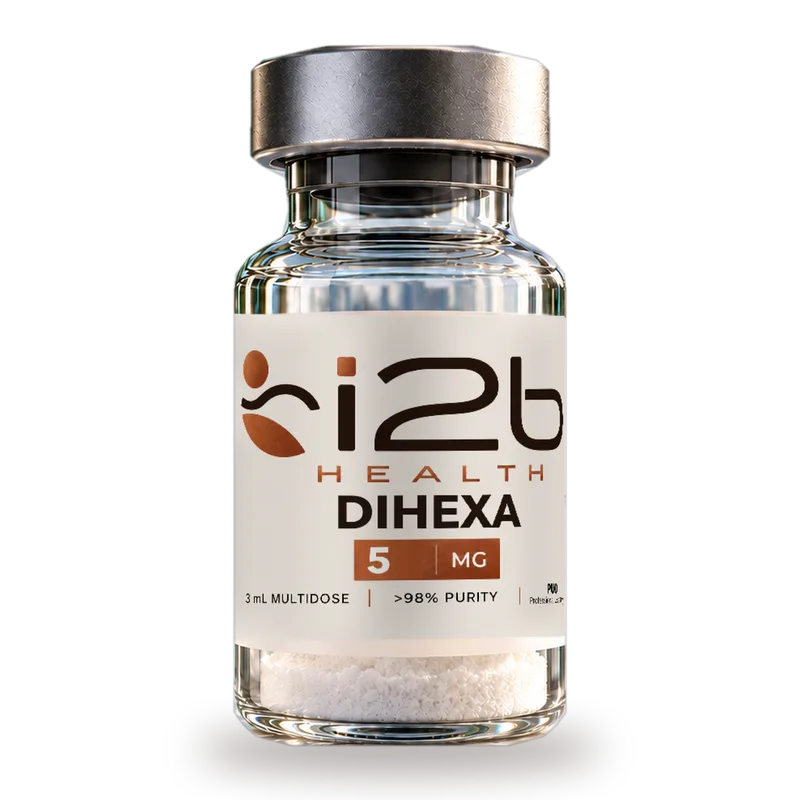
Nootropic
Dihexa
5mg · 10mg · not currently in stock
Potent nootropic hexapeptide studied for synaptic connectivity, memory formation, and cognitive repair via HGF/c-Met pathway activation.
Mechanism
Dihexa (N-hexanoic-Tyr-Ile-(6) aminohexanoic amide) is a modified angiotensin IV analog that acts as a potent agonist of the hepatocyte growth factor (HGF)/c-Met receptor system. Unlike angiotensin IV, which binds to the AT4 receptor (IRAP), dihexa primarily augments HGF signaling by stabilizing the HGF dimer and promoting its binding to the c-Met receptor on neurons. This activation stimulates synaptogenesis, dendritic spine formation, and neurotrophic signaling through PI3K and MAPK pathways. In animal studies, dihexa has demonstrated modulation of cognitive signaling pathways at picomolar concentrations, approximately seven orders of magnitude more potent than BDNF in promoting spinogenesis.
What the literature has looked at
- Studies have investigated cognitive signaling pathways in scopolamine-impaired rat models
- Research has examined synaptogenesis and dendritic spine formation in vitro
- Studies have explored HGF/c-Met pathway activation as a nootropic mechanism
- Research has assessed potential applications in neurodegenerative disease research models
Research context, not a claim about what this compound does. Research Use Only — not for human or animal consumption. 21+.
Cited work
McCoy AT, et al. Evaluation of metabolically stabilized angiotensin IV analogs as procognitive/antidementia agents. J Pharmacol Exp Ther. 2013;344(1):141-154.
Research investigated dihexa-mediated HGF/c-Met receptor activation and its effects on cognitive signaling pathways in rat models, observing modulation of synaptic connectivity at concentrations approximately 10 million-fold lower than BDNF.
Sun X, et al. AngIV-analog dihexa rescues cognitive impairment and recovers memory in the APP/PS1 mouse via the PI3K/AKT signaling pathway. Brain Sci. 2021;11(11).
Dihexa improved performance on memory tasks in the APP/PS1 mouse, with the authors attributing the effect to PI3K/AKT signalling.
Carries your code if you arrived with one — check the badge in the header.