
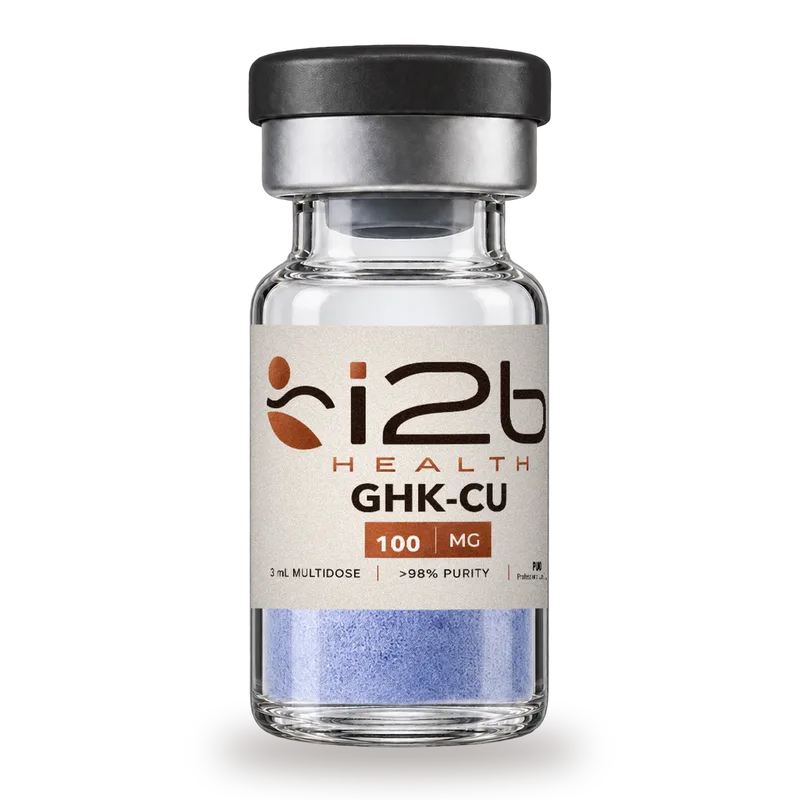
Cosmetic
GHK-Cu
100mg · 50mg
Copper peptide complex studied for tissue repair, anti-inflammatory activity, and skin regeneration.
Mechanism
GHK-Cu is a tripeptide-copper complex first isolated from human plasma, where it exists at approximately 200 ng/mL in young adults and declines with age. It has a high affinity for copper(II) ions and functions as a copper delivery vehicle to tissues. GHK-Cu modulates gene expression broadly: it upregulates genes involved in extracellular matrix (ECM) remodeling (collagen, elastin, glycosaminoglycans, decorin), antioxidant defense (SOD, glutathione systems), and stem cell markers, while downregulating genes associated with inflammation and fibrosis. It stimulates metalloproteinase activity for ECM turnover and promotes angiogenesis for improved tissue blood supply.
What the literature has looked at
- Studies have investigated tissue repair signaling mechanisms and skin remodeling pathways
- Research has examined gene expression modulation across >4,000 human genes
- Studies have explored ECM component synthesis including collagen and decorin
- Research has assessed gene expression patterns associated with aging research in skin tissue models
Research context, not a claim about what this compound does. Research Use Only — not for human or animal consumption. 21+.
Cited work
Pickart L, et al. The human tripeptide GHK-Cu in prevention of oxidative stress and degenerative conditions of aging: implications for cognitive health. Oxid Med Cell Longev. 2012;2012:324832.
GHK-Cu was shown to modulate expression of 31.2% of the human genome, with significant upregulation of genes involved in tissue repair signaling and antioxidant response, and suppression of genes associated with inflammation and tissue destruction.
Fu SC, et al. Tripeptide-copper complex GHK-Cu (II) transiently improved healing outcome in a rat model of ACL reconstruction. J Orthop Res. 2015;33(7):1024-1033.
In a rat ligament-reconstruction model, GHK-Cu improved an early healing outcome measure. The authors describe the effect as transient, and it is reported that way here because that is what the paper concluded.
Properties
- molecular Formula
- C₁₄H₂₃CuN₆O₄
- molar Mass
- 403.92 g/mol
- type
- Peptide-copper complex (tripeptide)
Carries your code if you arrived with one — check the badge in the header.