
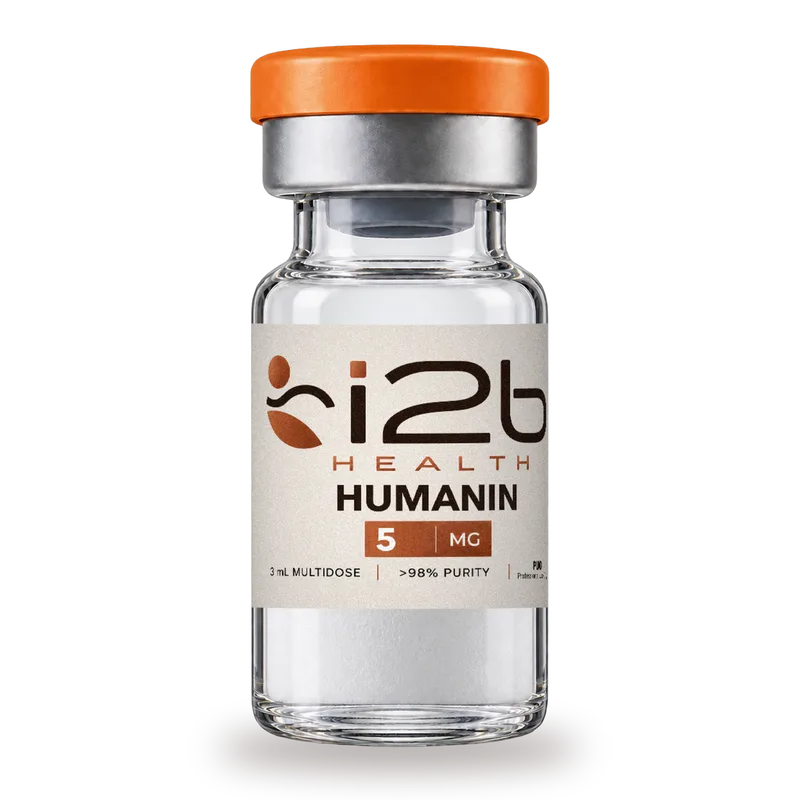
Mitochondrial
Humanin
5mg · 10mg · not currently in stock
Mitochondria-derived peptide studied for neuroprotection and metabolic health.
Mechanism
Humanin is the first identified mitochondrial-derived peptide, encoded by a short open reading frame within the MT-RNR2 gene of mitochondrial DNA. It acts through multiple pathways: binding to the FPRL1 receptor and the CNTFR/WSX-1/gp130 trimeric receptor complex to activate STAT3 signaling, direct interaction with IGFBP-3 and Bax to inhibit apoptosis, and modulation of mitochondrial function. Humanin protects cells against amyloid-beta toxicity, oxidative stress, and serum deprivation-induced apoptosis. It also modulates insulin sensitivity and glucose metabolism through central and peripheral mechanisms. Circulating humanin levels decline with age in humans.
What the literature has looked at
- Studies have investigated neuroprotection against amyloid-beta-induced cell death
- Research has examined cytoprotective effects against oxidative stress and apoptosis
- Studies have explored metabolic signaling effects including insulin sensitization pathways
- Research has assessed age-related decline in circulating humanin levels
Research context, not a claim about what this compound does. Research Use Only — not for human or animal consumption. 21+.
Cited work
Hashimoto Y, et al. A rescue factor abolishing neuronal cell death by a wide spectrum of familial Alzheimer's disease genes and Abeta. Proc Natl Acad Sci USA. 2001;98(11):6336-6341.
Identified humanin as an endogenous neuroprotective factor that rescues neurons from death induced by multiple familial Alzheimer's disease genes and amyloid-beta peptide in research models.
Lee C, et al. The mitochondrial-derived peptide MOTS-c promotes metabolic homeostasis and reduces obesity and insulin resistance. Cell Metab. 2015;21(3):443-454.
Established the broader paradigm of mitochondrial-derived peptides as metabolic regulators, with humanin and MOTS-c demonstrating complementary protective functions in metabolic signaling pathway research.
Properties
- type
- Peptide (24 amino acids, mitochondrial-derived)
Carries your code if you arrived with one — check the badge in the header.