
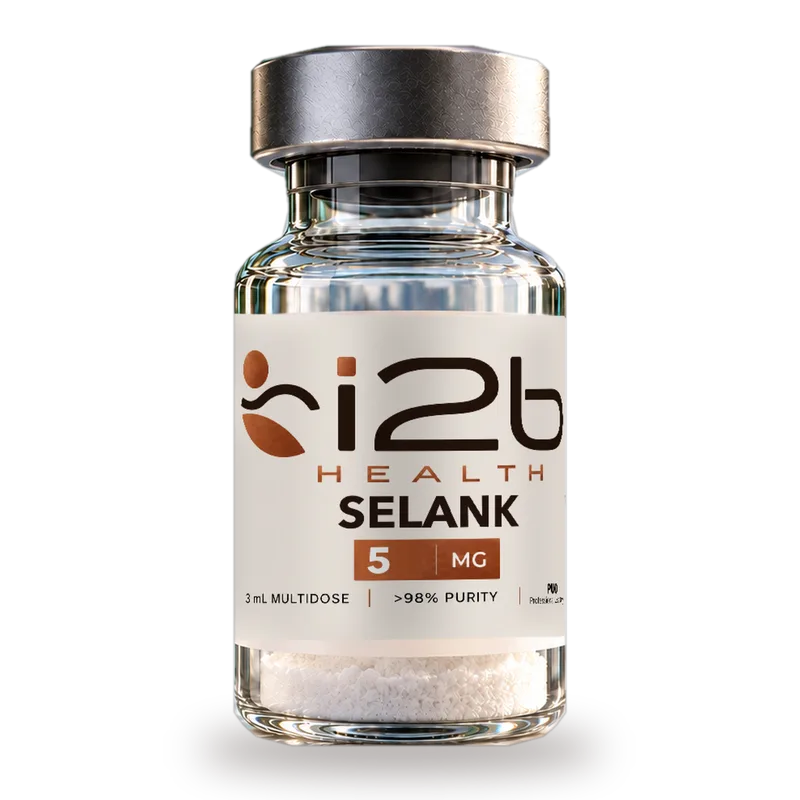
Nootropic
Selank
5mg · 10mg · not currently in stock
Synthetic analogue of tuftsin studied for anxiolytic effects, cognitive enhancement, and immune modulation without sedation.
Mechanism
Selank (Thr-Lys-Pro-Arg-Pro-Gly-Pro) is a synthetic peptide combining the tuftsin sequence (Thr-Lys-Pro-Arg) with a glyproline motif (Pro-Gly-Pro) that confers enzymatic stability. Its anxiolytic mechanism involves modulation of brain-derived neurotrophic factor (BDNF) expression, enhancement of serotonergic and GABAergic neurotransmission, and inhibition of enkephalin-degrading enzymes. Selank increases BDNF mRNA expression in the hippocampus, modulates the balance of T-helper cell cytokines, and influences the expression of over 50 genes related to the immune response. It does not produce sedation, dependence, or amnesia at anxiolytic doses.
What the literature has looked at
- Studies have investigated anxiolytic effects without sedation or cognitive impairment
- Research has examined BDNF modulation and cognitive signaling pathways
- Studies have explored immunomodulatory effects through cytokine regulation
- Research has assessed its anxiolytic receptor pharmacology in multiple study settings
Research context, not a claim about what this compound does. Research Use Only — not for human or animal consumption. 21+.
Cited work
Narkevich VB, et al. Effects of heptapeptide selank on the content of monoamines and their metabolites in the brain of BALB/c and C57Bl/6 mice: a comparative study. Eksp Klin Farmakol. 2008;71(5):8-12.
Measured monoamines and their metabolites in mouse brain after selank administration, reporting strain-dependent differences in serotonin turnover.
Kozlovskii II, Danchev ND. The optimizing action of the synthetic peptide Selank on a conditioned active avoidance reflex in rats. Neurosci Behav Physiol. 2003;33(7):639-643.
Selank enhanced learning and memory signaling in conditioned avoidance tasks without producing sedation or motor impairment, distinguishing it from benzodiazepine anxiolytics.
Properties
- type
- Peptide (heptapeptide)
Carries your code if you arrived with one — check the badge in the header.